 Skip to content

Short answer: A siding repair estimate is driven by material type, whether the existing profile and color can still be matched, how much sheathing or wrap behind the panel was damaged by water, lead-safe work practices on homes built before 1978, and how much access and trim work the job needs. These rarely line up the same way twice, which is why a written estimate matters.
Looking for the service behind this guide? See our siding page.
What Actually Drives a Siding Repair Cost
A siding repair estimate is built from five variables: the material being repaired, whether the existing product can still be matched, how much water damage is hiding behind the panel, whether lead-safe work rules apply, and how much access, height and trim work the job needs. None of NJ Gold Star Construction’s estimates are quoted from a price list, because these variables genuinely change the scope from house to house.
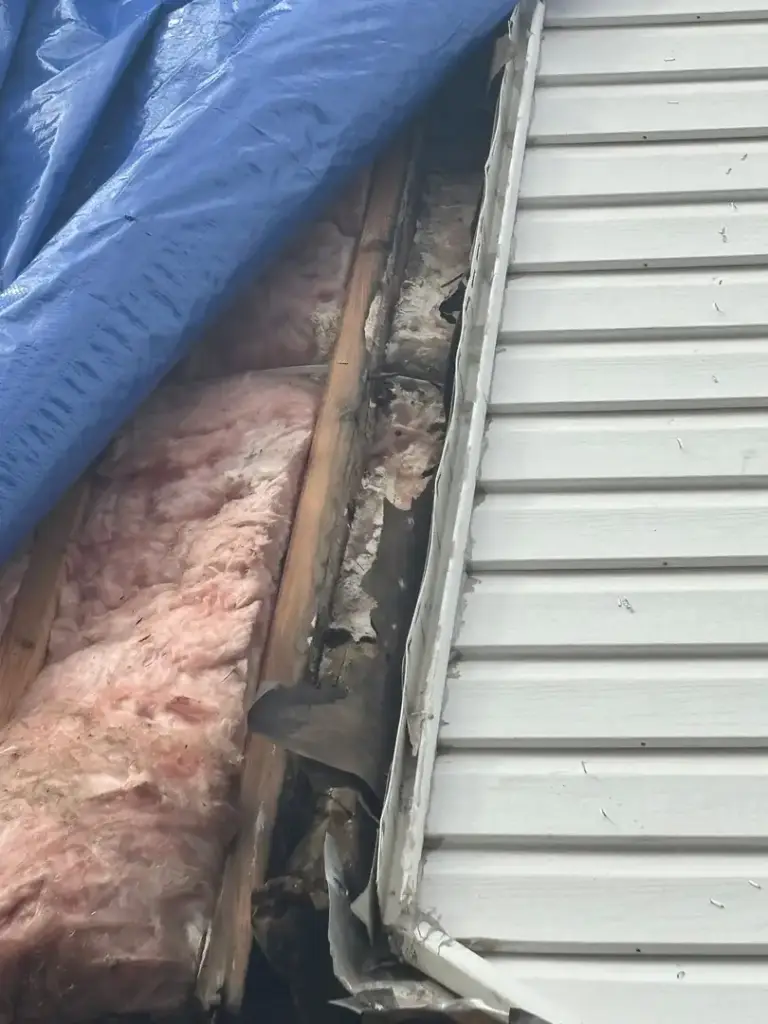
Two houses with what looks like the same damage from the street can end up with very different repair scopes once a panel comes off. One might have a sound wrap and dry sheathing underneath; the other might have a torn house wrap and softened sheathing that has been letting water in for a season or more without any visible sign on the surface.
This guide breaks down the variables that move the number, so a written estimate makes sense rather than reading like an arbitrary figure. It pairs with our siding repair page, which covers the repair process itself.
Material Type: Vinyl, Fiber Cement and Wood Repair Differently
Vinyl siding is the least labor-intensive to repair panel by panel, since individual pieces lock and unlock from the course above and below. Fiber cement is heavier, must conform to the ASTM C1186 product standard, and typically needs cutting and painting or color-matching on site. Wood repair varies the most, since damage often extends into the framing behind it.
| Material | What makes it more or less labor-intensive | Common complication |
|---|---|---|
| Vinyl | Panels unlock from the course above without disturbing neighboring panels | Discontinued colors fade unevenly against older panels |
| Fiber cement | Heavier, requires specific cutting tools and often field painting or matching | Must meet ASTM C1186; a mismatched replacement panel is visually obvious |
| Wood | Widest range of outcomes; rot often extends past the visibly damaged board | Damage frequently reaches the sheathing or framing behind it |
Vinyl siding’s nail-hem fastening system is built to allow expansion and contraction, roughly half an inch or more over a 12.5-foot length according to vinyl siding installation guidance, so a properly hung panel can be removed and replaced without disturbing the panels around it. That is part of why vinyl repairs are usually the most straightforward of the three materials, cost aside.
Fiber cement siding is regulated as a distinct product category under the residential code, required to conform to ASTM C1186, and it does not flex the way vinyl does. A cracked fiber cement board almost always needs to be cut out and replaced rather than reset, and matching an existing painted finish on site adds a labor step vinyl repair does not require.
Matching a Discontinued Profile or Color
Manufacturers retire siding profiles and colors over time, and even a close match can look different from decades-old siding that has faded unevenly from sun exposure. We check availability before quoting a repair, since a technically correct repair that stands out visually is not always the better outcome for the homeowner.
A panel bought new is not always identical to one installed years ago, even from the same manufacturer, since product lines change. We look for the closest available match in profile and exposure first, since a mismatched profile reads as more obviously wrong than a slightly different shade.
When a patch will not blend in
- The original profile or color line has been discontinued with nothing close enough to substitute.
- Damage is spread across more than one elevation rather than contained to a few panels.
- UV fade on the surrounding wall is severe enough that any new panel reads as a visible patch regardless of match quality.
In any of these cases, re-siding the affected wall through our siding installation service often costs less in total labor than chasing a series of individually mismatched repairs, and it resets the wrap and flashing behind the whole elevation at the same time.
What’s Behind the Panel: Sheathing and House Wrap Damage
New Jersey’s residential code requires a continuous water-resistive barrier, commonly called house wrap, behind every exterior wall covering, with flashing at penetrations. Water that gets behind damaged siding travels down that barrier and can reach the sheathing, framing and insulation long before any sign shows up inside the house, which is why an estimate has to include opening the wall, not just replacing the visible panel.
Under the code New Jersey enforces, at least one layer of water-resistive barrier has to be applied over the studs or sheathing of exterior walls, with flashing carrying water clear of penetrations, to provide a continuous barrier behind the siding. A cracked panel or a gap at a corner does not usually leak in a straight line; water tends to run down behind the barrier and show up lower on the wall, or inside at a header or sill well below where the damage is visible outside.
That is why a repair estimate that only prices the visible panel is incomplete. Once a section is open, we check whether the wrap behind it is torn, whether flashing at a nearby window or corner failed first, and how far softening has spread into the sheathing. Repairs that skip this step tend to fail again at the same spot within a season or two, because the panel was never the actual problem, and the real cost driver was underneath it.
Lead-Safe Work Rules on Homes Built Before 1978
The EPA’s Lead-Safe Renovation, Repair and Painting Rule requires contractors doing work that disturbs painted surfaces on homes built before 1978 to be certified and to use lead-safe work practices. Siding repair on an older home with painted trim or siding can trigger this rule, which adds containment and cleanup steps that a newer home’s repair does not need.
The rule is specific about scope: anyone paid to perform work that disturbs paint in housing built before 1978 must be certified in lead-safe practices, and this applies to firms of any size, including sole proprietorships. Roughly three-quarters of homes built before 1978 nationally still contain some lead-based paint, which is why the rule applies by construction date rather than by visible paint condition.
In practice, this means a siding or trim repair on an older Bergen or Passaic County home may need containment (plastic sheeting and controlled work area), specific cleanup and verification steps, and disposal practices that a post-1978 home’s repair does not require. We factor this into the written estimate for any home built before 1978 rather than treating it as a surprise add-on mid-job. The rule generally does not apply to homeowners performing work in their own home, but it applies to any paid contractor doing the work.
Access, Height and Trim Work
A repair on a single-story wall at ground level costs less in labor than the identical repair on a steep gable, a dormer, or a wall requiring staging or a lift. Trim work, whether it is fascia, corner boards, or window and door casing damaged alongside the siding, is priced separately because it is a different material and often a different repair method.
Access is one of the more overlooked variables in a siding estimate. A panel three feet off the ground can be swapped in minutes; the same panel forty feet up on a steep-pitched gable end needs ladders, staging, or a lift, plus the time to set it up and take it down safely, before the actual repair labor even starts.
Trim damage often travels with siding damage, since both are exposed to the same water intrusion at a corner or window. Fascia and corner boards are wood or a wood alternative, priced and repaired differently from the siding material itself, which is why an estimate breaks trim out as its own line rather than folding it into the siding cost.
Storm Damage vs. Ordinary Wear: Why the Cause Changes the Job
Wind-driven storms lift and tear siding where a course was under-fastened or a panel’s locking leg never fully engaged, and Northern New Jersey’s climate zone sees roughly twice as many thunderstorms as the coastal zone. A storm repair often means checking the whole wall the wind hit, not just the panels that are visibly missing, since neighboring courses are frequently loosened without falling off yet.
Storm damage and gradual wear are diagnosed differently, and that shows up in the estimate. Ordinary wear tends to be contained to a specific spot, like a section that has faded or a panel that cracked from an isolated impact. Storm damage tends to be spread across an entire elevation, even when only a few panels are actually missing, because the same wind that tore those loose has loosened the panels around them.
After a wind event, we inspect the full wall the storm hit rather than only replacing the obviously missing panels, since those loosened-but-still-hanging panels are next to fail. Storm repair frequently overlaps with other exterior damage from the same event; see our gutter repair and roof repair pages for how we look at all of it during the same inspection.
Getting an Accurate Siding Repair Estimate
An accurate siding repair number comes from an on-site inspection that checks the panel, the wrap and sheathing behind it, and the home’s construction date, not from a phone estimate or a generic price list. NJ Gold Star Construction provides a free, itemized written estimate before any work starts, with our own crew doing the repair.
One customer described a project that involved matching new work into an existing structure this way: “Edgar’s team rose to the challenge, addressing every structural issue with precision and expertise… Their attention to detail and dedication to quality gave me total peace of mind.” — Jwalin V., Google review.
We repair and install siding across Bergen and Passaic County, including Hackensack and Teaneck. See the full siding installation and repair overview, or request a free written estimate for the number that applies to your wall.
Frequently asked questions
Is fiber cement siding repair more expensive than vinyl?
Typically, yes, because fiber cement is heavier, requires specific cutting tools, and often needs on-site painting or color matching after installation, none of which vinyl repair usually requires. Vinyl panels also unlock from the course above without disturbing neighboring panels, which keeps labor time lower on a like-for-like repair.
Why does my home’s age affect the siding repair cost?
Homes built before 1978 fall under the EPA’s Lead-Safe RRP Rule if painted surfaces will be disturbed during the repair, which requires certified contractors and lead-safe containment and cleanup practices. That adds labor steps a newer home’s repair does not need, and it is a compliance requirement, not an optional upsell.
Can a siding repair be done without opening the wall?
Sometimes, for cosmetic damage with no evidence of water intrusion. But because water travels down the house wrap behind siding before showing any surface sign, a repair with any suspicion of water damage should include checking the wrap and sheathing, which means opening that section rather than only swapping the visible panel.
Why can’t I just get a flat price over the phone?
Because the actual cost depends on what is found once a panel comes off: whether the wrap is torn, whether sheathing has softened, whether the color and profile are still available, and how much access the wall requires. A phone estimate cannot account for any of that, which is why we inspect on site before quoting.
Does homeowners insurance typically cover storm-damaged siding?
Many policies cover siding damage from a covered peril such as wind or hail, but coverage details, deductibles and whether purely cosmetic damage is included vary by policy. We provide photo documentation and a written estimate that homeowners commonly submit with a claim, but the coverage decision is between you and your insurer.
Is it cheaper to repair a few panels or re-side the whole wall?
It depends on how much of the wall is affected. Repairing a handful of isolated panels is usually less expensive than a full re-side. But once damage or discontinued-product mismatches spread across most of an elevation, the labor of chasing multiple individual repairs can add up to more than a re-side that fixes the wrap and flashing behind the entire wall at once.
Sources
- Renovation, Repair and Painting Program — U.S. Environmental Protection Agency (EPA)
- Vinyl Siding Installation Manual — Vinyl Siding Institute / Polymeric Exteriors
- Fiber-Cement Siding — UpCodes (building code reference)
- Chapter 7 Wall Covering, Section R703.2: New Jersey UCC One- & Two-Family Dwelling Subcode 2021 — UpCodes (New Jersey edition of the 2021 IRC)
- Overview of the Climate of New Jersey — Office of the New Jersey State Climatologist, Rutgers University
Have a question about your own home? Call (862) 271-1225 or request a free written estimate.
Get a free written estimate
Tell us what you are dealing with. We inspect first, then put the price in writing, with no obligation.