 Skip to content
Get Your Free Estimate
Written, itemized quote. We call or text you back, usually the same day.
Prefer to talk? (862) 271-1225 · 24/7 for active leaks
Emergency Roof Repair in North Jersey
Active leak, missing shingles or storm damage? Call (862) 271-1225 any time. We assess the damage, protect the opening and explain the permanent repair in writing.
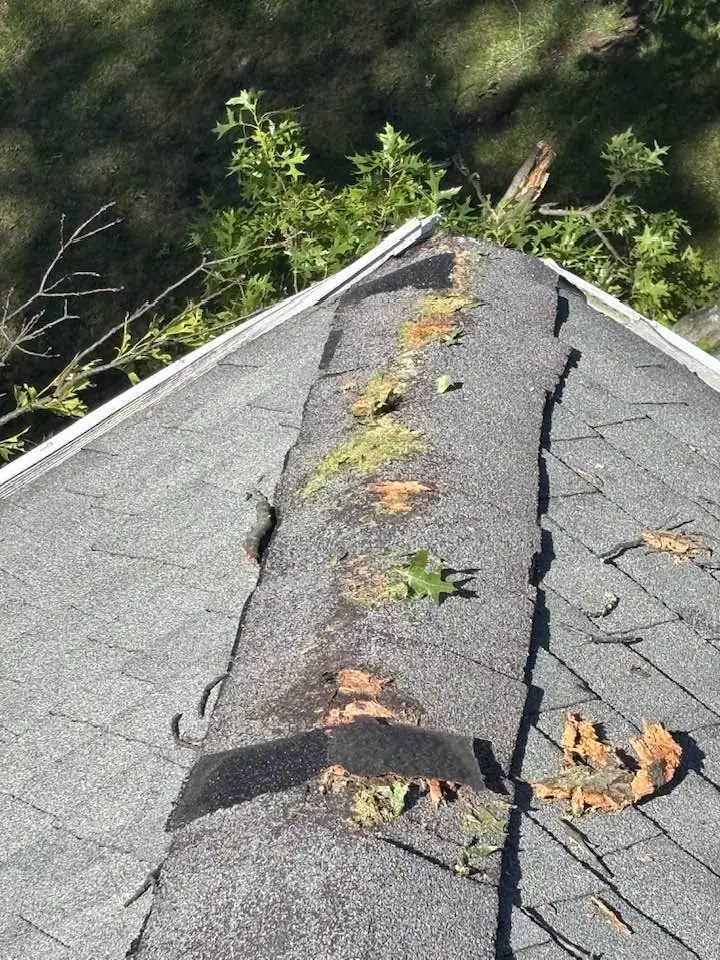
When a storm lifts shingles or water starts coming through a ceiling, you need a clear next step. NJ Gold Star Construction is a family-owned roofing and exterior contractor based in Totowa, serving Bergen and Passaic County.
This is one part of the work we do across our service area. Every job is quoted in writing after a hands-on inspection, performed by our own crew rather than subcontractors, and backed by our satisfaction guarantee. We are licensed under NJ HIC #13VH13359900 and fully insured.

New dark shingle roof
What counts as a roofing emergency
A roofing emergency is any condition where water is entering the house, or the roof structure may no longer be safe. Active leaks, exposed underlayment, a punctured deck and lifted flashing all qualify. A stain that has not changed in months can usually wait for a normal appointment.
Not every drip needs a night call, but some conditions should not wait for a convenient week. These are the ones we treat as urgent:
- Water coming through a ceiling or wall during or right after rain.
- Missing shingles or bare underlayment after a wind event, because the felt or synthetic layer is not built to be the weather surface for long.
- A puncture from a fallen limb or debris, even a small one.
- Lifted or torn flashing at a chimney, a wall or a skylight where water is getting in.
- A soft or sagging spot in the deck. Keep everyone off that part of the house.
- An opened valley or ridge that leaves a straight path for rain.
If a limb is down on power lines, or the structure feels unsafe, the first call is to the utility and emergency services. We come once the scene is safe to approach. Leaks that have been there a while, such as a faded ceiling ring, are better handled through a regular roof repair visit where we can trace the source properly.
What to do in the first hour
Stay off the roof, protect what is inside, and document what you can see from the ground. Falls are among the most common causes of serious work-related injuries, and a wet or damaged roof is the worst place to improvise. Then call with your town and what you see.
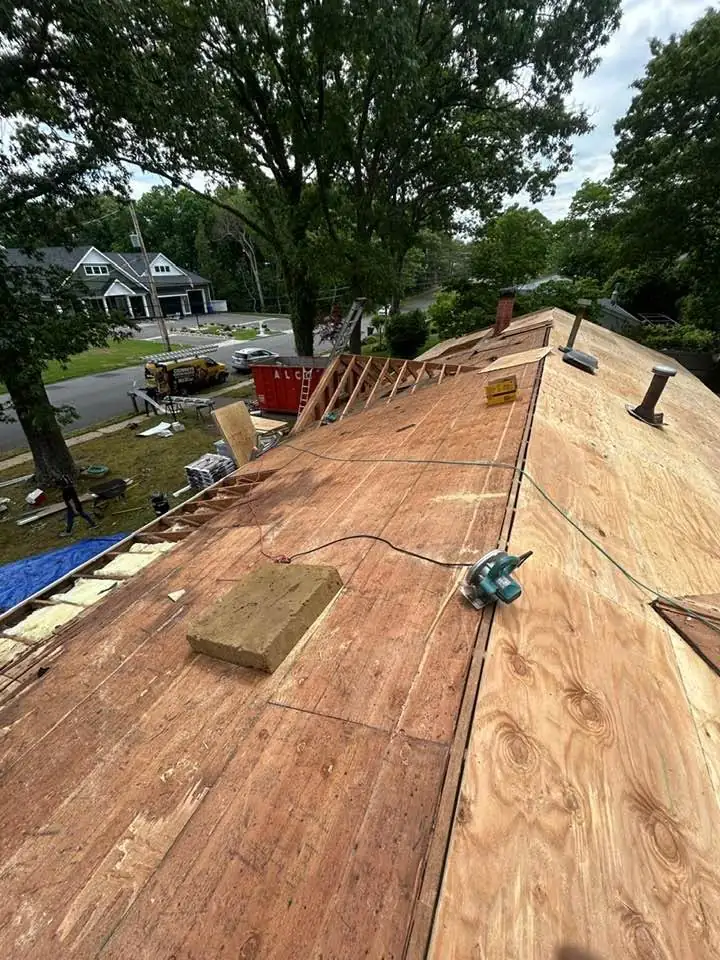
New plywood deck after tear-off
OSHA states plainly that falls are among the most common causes of serious work-related injuries and deaths, and trained crews still work from harnesses and anchors for that reason. A wet shingle surface at night is not a place for a homeowner to climb. What helps instead:
- Move belongings out from under the leak, lay down towels, and set a bucket where it drips. Cover furniture you cannot move.
- Photograph the stain, the ceiling and any visible exterior damage from the ground. Date-stamped photos are useful later.
- Look from the ground for missing tabs, a limb on the roof, flashing pulled open or a sagging line along the ridge.
- Check the attic if you can do it safely. A flashlight will show active drips or daylight pinholes. Step only on framing you can see, never on insulation-covered boards you cannot.
- Call (862) 271-1225 with your town, your address, a callback number and whether water is still coming in.
Temporary protection versus a permanent repair
A tarp or a sealed patch stops water for now; it does not fix the cause. Temporary protection buys time for dry weather and the right materials, and it should be followed by a proper repair on a dry deck. A cover left on for months invites secondary damage.

Membrane and new dormer sheathing
When there is an open area, the first goal is to get a cover on it that wind cannot easily get under. That means fastening to solid framing rather than relying on weights, running the cover over the ridge where the opening is on a slope, and keeping nails out of sound shingles wherever possible. It is protection, and it is described that way in the written visit notes.
The permanent work comes after, and the right fix depends on what failed. A torn boot or flashing is replaced and not caulked over. A section of shingles is rebuilt course by course so the laps shed water the way they should. If the damage shows that the whole field is near the end of its life, we say so and lay out the options, including roof replacement, so you can decide with the facts in front of you. Where the leak turns out to start in the attic, ventilation can be part of the cause; our attic vent page covers that.
Plan the follow-up before the tarp goes on. The next storm tends to find the same weak point.
Want a straight answer on your project?
Call us or ask for a free written estimate. We inspect first and put the price in writing.
5.0 from 12 Google reviews · Licensed & insured · NJ HIC #13VH13359900 · Free written estimate, no obligation
What happens when we arrive
We check safety first, find where the water is actually entering, stop the weather if temporary protection is appropriate, and explain your options in plain terms. You get a written scope for the permanent repair, and nothing is started on the strength of a handshake alone.
Every house is different, but an emergency visit follows the same order:
- Safety check: access, power lines, unstable limbs and the condition of the deck where we need to stand.
- Finding the entry point: water rarely drops straight below the hole. We look in the attic and on the roof together when conditions allow, because the stain is often several feet from the source.
- Stopping the weather: a tarp or temporary patch where one is warranted. If wind, ice or darkness makes it unsafe, we tell you honestly and say what is best to do until it passes.
- Options: patch now and schedule the repair, repair properly, or discuss replacement if the roof is failing broadly.
- A written scope for the permanent work, with the price itemized.
We work with our own crew, not subcontractors, and the visit is documented with photographs you can keep. We do not promise arrival times we cannot control, because storm nights stretch every roofer’s schedule; what we can promise is a straight answer about when we can be there.
Storm damage, insurance and paperwork
The New Jersey Department of Banking and Insurance tells homeowners to make necessary temporary repairs, keep every receipt, and call their insurer as soon as possible. We document the conditions we find, but claim decisions belong to you and your insurer.
After Tropical Storm Isaias the Department of Banking and Insurance published its guidance for homeowners, and the core of it still applies to any storm loss: make any necessary temporary repairs to protect the property from further loss, save all receipts or bills for your claim, and call your agent or insurer as soon as possible to report the loss. Read your own policy for how it treats temporary repairs, and ask the insurer directly if you are unsure.
What we do on our side is practical: photographs of the roof and the area around the entry point, a description of what we found, and a clear invoice for any emergency protection. We do not predict what an adjuster will decide, and we do not promise approval or payout amounts. Keep damaged materials, such as torn shingles, until the adjuster has had a chance to look if the insurer asks for them.
Permits and contractor checks after a storm
Emergency protection rarely needs a permit, but a permanent repair or a replacement may, and your town’s construction office decides. New Jersey also expects home improvement contractors to be registered, and it is reasonable to ask for the registration number before you sign.
Temporary protection is usually treated differently from a full re-roof, but the line depends on the scope of the permanent work and on your town. New Jersey’s Uniform Construction Code is administered locally, and the state’s construction permit application packet is submitted to the municipal Construction Code Enforcement Office. We ask your town’s office what a given repair needs and we put the answer in the written scope.
Storms also bring door-knockers who appear the same afternoon. The Division of Consumer Affairs’ advice, repeated in the Attorney General’s consumer notice on home improvement contractors, is to check that a contractor is registered with the state, get a written contract for work of $500 or more, and make sure the contractor obtains the required permits. Our registration number is NJ HIC #13VH13359900, and you are welcome to verify it. Rules and fees change, so confirm the current requirements with the Division.
Ready to talk it through?
No pressure and no obligation: a hands-on inspection, photos, and an itemized quote you can keep.
5.0 from 12 Google reviews · Licensed & insured · NJ HIC #13VH13359900 · Free written estimate, no obligation
Where we respond from Totowa
We work from Totowa and respond across Bergen and Passaic Counties. Distance, road conditions and the number of storm calls all affect timing, so we tell you plainly when we can be there rather than guess. The county pages list the towns we serve and how permits work in each.
Our shop is in Totowa, in Passaic County, which puts most of the area within a short drive. See the Passaic County and Bergen County pages for the towns we cover, including Totowa, Wayne, Clifton, Hawthorne, Little Falls, Ridgewood, Paramus, Hackensack, Teaneck and many more.
After the roof is stable, the storm often points to other repairs: overflowing or bent gutters, wind-lifted siding, a loose chimney chase cover, or water at the base of a wall that needs a look from our masonry crew. We can take care of those in the same visit plan so you are not coordinating several trades.
Related roofing services
Leaks, flashing, shingles and valleys repaired at the source…
Full replacement when the whole roof is near the end of its life…
Ventilation that keeps ice dams and moisture in check…
Inspections that catch problems before a storm does…
Emergency Roof Repair service areas
We provide emergency roof repair from our Totowa base across these towns. Each link opens that town’s page, with local permit and building notes.
Bergen County: Allendale · Bergenfield · Cliffside Park · Demarest · Elmwood Park · Emerson · Englewood · Fair Lawn · Fairview · Fort Lee · Franklin Lakes · Garfield · Glen Rock · Hackensack · Harrington Park · Hasbrouck Heights · Hillsdale · Lodi · Mahwah · Montvale · Old Tappan · Oradell · Palisades Park · Paramus · Park Ridge · Ramsey · Ridgefield Park · Ridgewood · Rochelle Park · Rutherford · Teaneck · Tenafly · Waldwick · Westwood · Woodcliff Lake · Wyckoff
Passaic County: Clifton · Haledon · Hawthorne · Little Falls · North Haledon · Paterson · Ringwood · Totowa · Wanaque · Wayne · West Milford · Woodland Park
Essex County: Montclair · Nutley · Verona
Morris County: Morristown · Parsippany
Not listed? Call (862) 271-1225 and ask whether we cover your address.
Where we work: from our Totowa base across North Jersey
Frequently asked questions
Do you offer emergency roof help at night and on weekends?
Yes. Our line is open around the clock for active leaks and storm damage, and Google lists the business as open 24 hours. How fast we can get to you depends on conditions, access and how many storm calls are ahead of yours, and we tell you honestly when we can be there.
Will you tarp my roof the same day?
When an open area needs protection and it can be done safely, that is the main goal of an emergency visit. If wind, ice or darkness makes climbing unsafe, we explain what to do in the meantime and return as soon as it is safe.
Is emergency repair the same as a roof replacement?
No. Emergency work stops water and stabilizes damage. Replacement is a separate decision, made when the whole roof is near the end of its life, and you get a written scope and price before any of it starts.
Do you help with insurance paperwork?
We photograph and describe the conditions we find and give you a clear invoice for emergency protection. Your insurer decides coverage, and we do not promise claim approval or payout amounts.
What should I tell you when I call?
Your town and address, a callback number, whether water is still entering, and a short description such as missing shingles, a tree on the roof or a leak around the chimney. Photos by text help us plan what to bring.
Who do I call after the leak stops?
Call us to schedule the permanent repair before the next storm reopens the same path. A temporary cover is not a lasting fix, and the sooner the repair is done on a dry deck, the less secondary damage you risk.
- NJDOBI Offers Guidance on Filing Homeowners Insurance Claims to NJ Homeowners Impacted by Tropical Storm Isaias — New Jersey Department of Banking and Insurance
- Fall Protection — U.S. Department of Labor, OSHA
- Construction Permit Application Packet and Forms — New Jersey Department of Community Affairs
- New Jersey Division of Consumer Affairs Cites 31 Home Improvement Contractors (consumer advice on registration, written contracts of $500 or more, permits) — New Jersey Office of the Attorney General
Updated October 2026 · Reviewed by Edgar Lopez Gonzalez, owner · NJ HIC #13VH13359900
Licensed & insured. 25+ years in North Jersey. We answer 24/7 for leaks and storm damage.
- Service
- Emergency Roof Repair
- Category
- Roofing
- Service area
- Bergen & Passaic County and surrounding North Jersey
- License
- NJ HIC #13VH13359900