 Skip to content

Get Your Free Estimate
Written, itemized quote. We call or text you back, usually the same day.
Prefer to talk? (862) 271-1225 · 24/7 for active leaks
Roof Replacement in Bergen County, NJ
Full tear-off roof replacement with deck inspection, ice and water shield, synthetic underlayment and architectural shingles — typically one to three days on a Bergen County home.
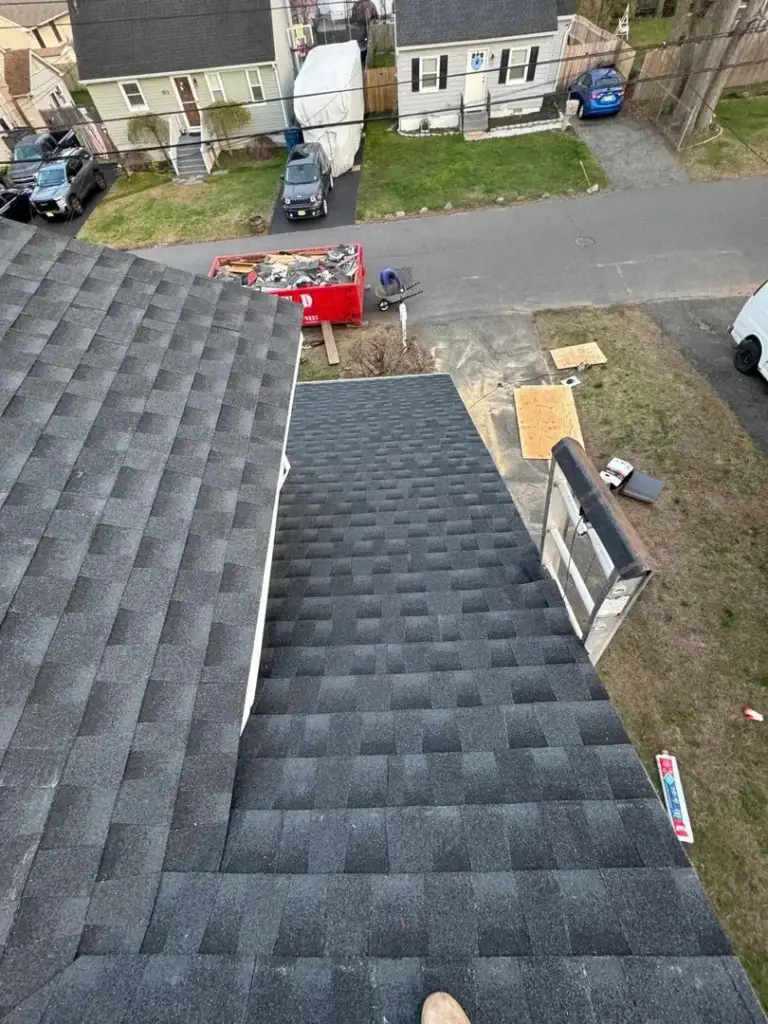
A replacement is only as good as what goes on before the shingles. We tear off to the deck, replace anything soft, and rebuild the assembly from underlayment up so the warranty means something.
This is one part of the roofing work we do across Bergen and Passaic County. Every job is quoted in writing after a hands-on inspection, performed by our own crew rather than subcontractors, and backed by our satisfaction guarantee. We are licensed under NJ HIC #13VH13359900 and fully insured.
What the work includes
- Complete tear-off and deck repair where needed
- Ice and water shield at eaves, valleys and penetrations
- Architectural shingles installed to manufacturer nailing pattern
- Balanced ridge and soffit ventilation included
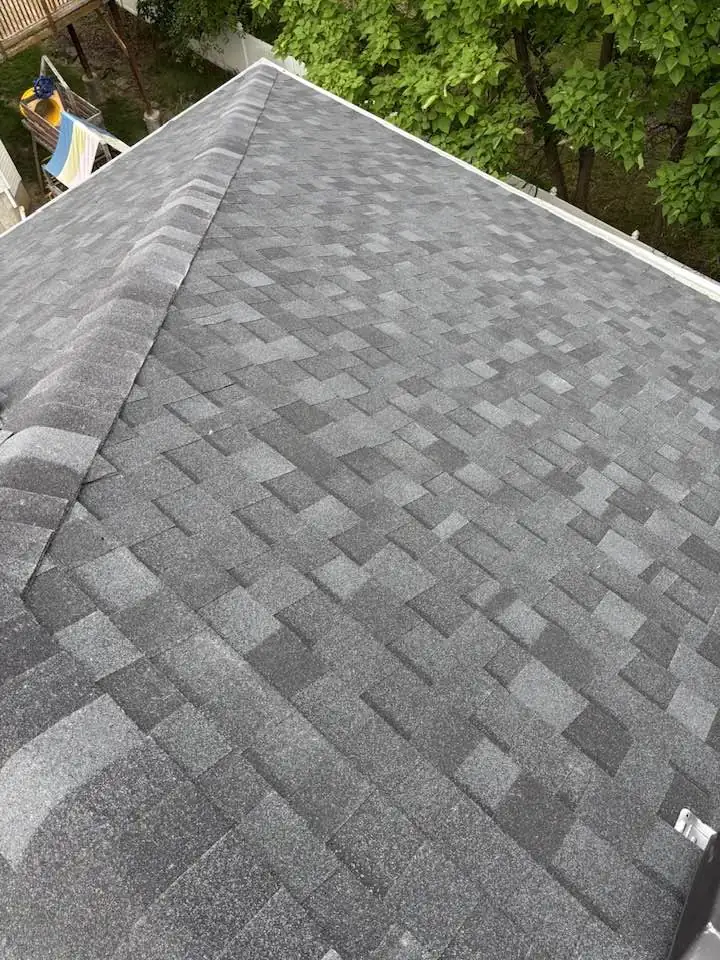
New shingles at the hip
Tear-off vs. roofing over: what New Jersey code allows
New Jersey’s adopted residential code bars roofing over an existing layer when that layer is water-soaked or deteriorated, when the existing covering is slate, clay, cement or asbestos-cement tile, or when the roof already carries two or more layers of covering. Any of those conditions makes a tear-off the only code-compliant path, not a choice of convenience.
A recover, sometimes called a roof-over, leaves the old roofing in place and installs new shingles on top of it. It’s cheaper up front and faster, and on a single, sound layer it’s technically permitted. It’s also a decision we rarely recommend, because it hides exactly the deck problems a tear-off would expose.
New Jersey’s version of the International Residential Code sets firm limits on when a recover isn’t allowed at all: over a roof covering that’s water-soaked or deteriorated to the point it can’t serve as a base, over slate, clay, cement or asbestos-cement tile, or over a roof that already has two or more layers of any covering. On most of the houses we’re called to for a full replacement, one of those conditions already applies, which settles the question before we ever raise it.
Why we default to tear-off anyway
- A layered roof hides soft, rotted or delaminated sheathing until the second layer starts failing too
- Nailing through two layers rarely achieves full penetration into solid wood
- A recover adds weight the framing wasn’t necessarily designed to carry twice
Ice barrier and synthetic underlayment: the layers under the shingles
New Jersey’s code requires an ice barrier under the shingles at the eaves in the state’s colder zones, extending at least 24 inches inside the exterior wall line, with a longer run on steeper slopes. Underlayment beneath the field of the roof can be traditional felt or a self-adhering, polymer-modified bitumen membrane meeting ASTM D1970.

Membrane at the wall
Shingles are the visible layer; the underlayment and ice barrier underneath do the work when wind-driven rain or a winter ice dam gets past them. New Jersey’s code requires an ice barrier — a self-adhering membrane or two cemented layers of felt — running from the eave to at least 24 inches inside the exterior wall line, and on roofs at 8:12 pitch or steeper, at least 36 inches measured along the slope. That’s the zone where meltwater backs up behind an ice dam and tries to work under the shingles from underneath.
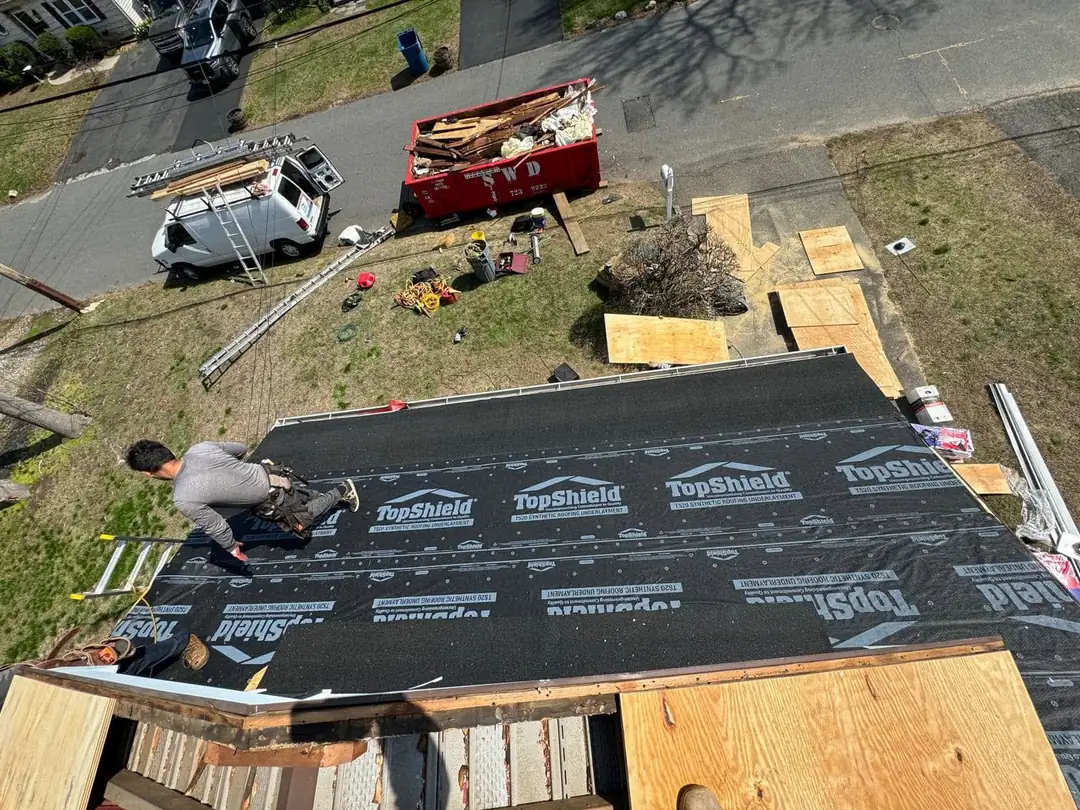
For the rest of the roof deck, we install a synthetic or self-adhering underlayment rather than plain felt on most jobs. A self-adhering underlayment that meets ASTM D1970 is a named code option specifically because it seals around the nail penetrations that follow, which ordinary felt does not.
What decides the price of a roof replacement
Roof price follows a handful of things you can see for yourself: the size and pitch of the roof, how many layers come off, the condition of the deck, the material you choose, and access to the house. We list each one in a written estimate, so you can compare bids line by line.
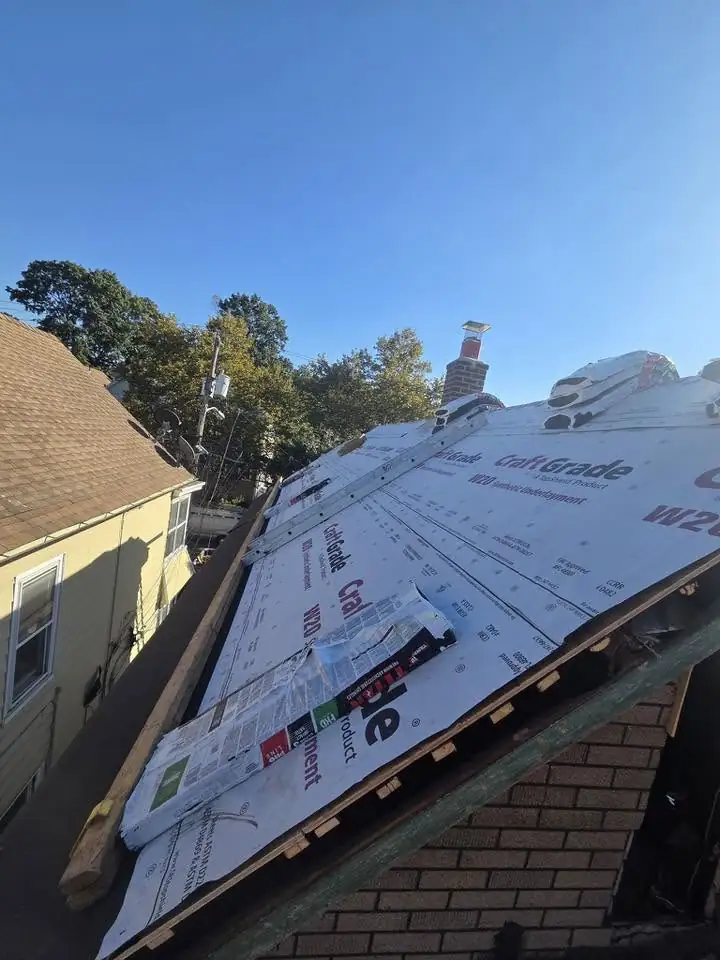
Underlayment over new decking
Two roofs on the same street can cost quite different amounts, and the reasons are not mysterious. These are the items that move the number:
- Size and pitch. More squares of roof means more material and labor, and a steep pitch slows the crew down.
- Layers and tear-off. One layer of shingles is quicker to remove than two, and disposal is part of the job.
- The deck. Rotted or damaged sheathing is found once the old roof is off, so we explain how any deck repair is priced before work starts.
- Material. Asphalt shingles, metal and other systems differ in cost and in how long they last.
- Details. Flashing, vents, skylights, chimneys and valleys each add work.
- Access and permit. Tight driveways, extra handling and the town permit are listed, not hidden.
For a walk-through of how these add up, read our guide to roof replacement cost in New Jersey, then ask for a free written estimate for your own roof.
Want a straight answer on your project?
Call us or ask for a free written estimate. We inspect first and put the price in writing.
5.0 from 12 Google reviews · Licensed & insured · NJ HIC #13VH13359900 · Free written estimate, no obligation
What happens to the roof deck during a tear-off
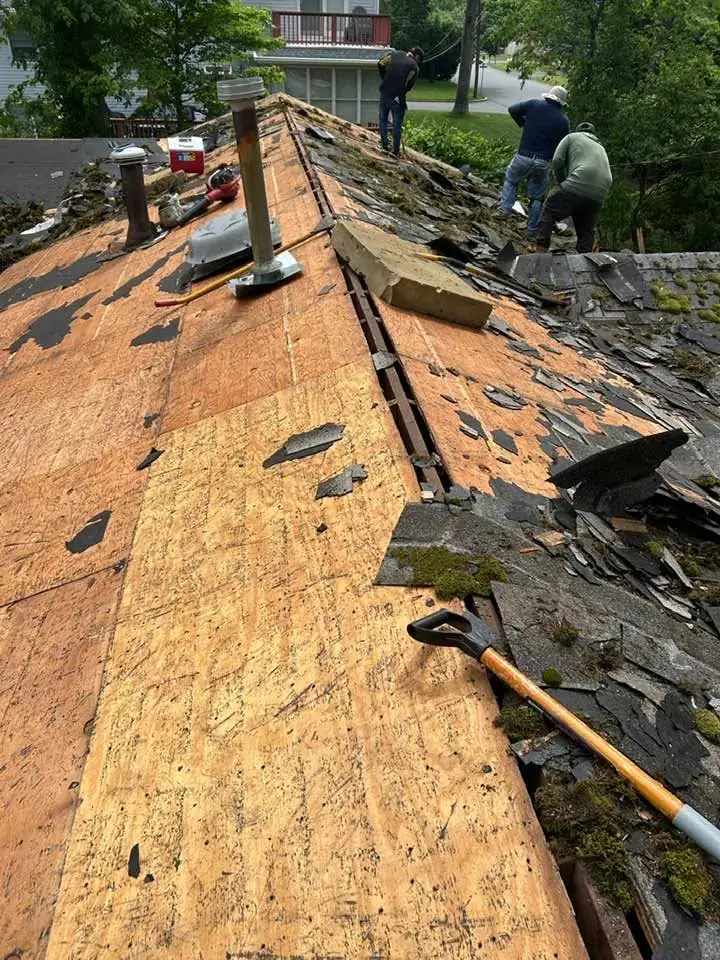
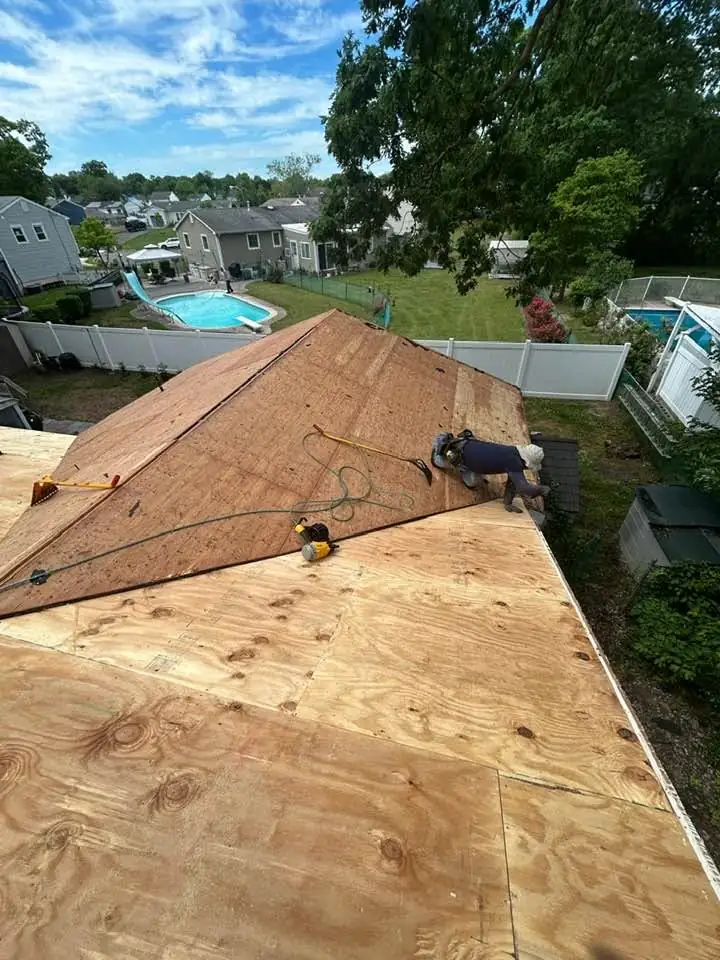
Tear-off strips every layer down to bare sheathing so we can see the deck itself, not guess at its condition from the attic side. Any soft, delaminated or rotted plywood or board sheathing is cut out and replaced before a single course of underlayment goes down, because underlayment and shingles cannot fix a structural problem underneath them.
This is the step a recover skips entirely, and it’s the reason a tear-off costs more than roofing over. Once the old shingles and underlayment are off, we walk the deck, check nailing patterns at the rafters, and probe anywhere staining on the attic side suggested a slow leak. Soft spots get cut back to solid wood and replaced with matching thickness sheathing, tied into the existing rafters or trusses.
A roof that was recovered once already often shows the cost of that shortcut here: fastener patterns that never reached solid wood, and sheathing that stayed wet for years under two layers of shingles without anyone seeing it. If the deck comes back sound and the issue turns out to be isolated, we’ll say so; see our roof repair page for when a targeted fix is the better call instead of a full tear-off.
Balancing intake and exhaust when the roof comes off
A full tear-off is the easiest time to correct attic ventilation, since the ridge and roof deck are already open. Intake at the soffit and exhaust at the ridge need to work as a matched pair, and industry guidance for asphalt roofing recommends erring toward more intake than exhaust when a roof can’t be perfectly balanced.
We rarely find a roof that was ventilated correctly the first time. With the deck exposed, cutting a continuous ridge slot and confirming open, unblocked soffit intake takes a fraction of the labor it would on a finished roof. See our attic ventilation page for how we size intake and exhaust to the attic floor area.
Skipping this step on a replacement is a common shortcut: new shingles go on over the same unbalanced airflow that contributed to ice damming or premature aging on the old roof, and the problem repeats on a ten-, twenty- or thirty-year timeline instead of getting solved.
Comparing common roofing materials for a Bergen County replacement
Asphalt architectural shingles cover the large majority of Bergen County roofs and remain the most common replacement choice, with low-slope membrane on porches and additions and metal on some accent roofs. Slate and tile appear mostly on older homes built with them originally and require specialized installation skills and, for tile, a structural check for the added weight.
| Material | Where it fits on a Bergen County home | What to verify before choosing it |
|---|---|---|
| Asphalt architectural shingles | Most pitched roofs, full replacement | Wind rating and correct nailing pattern for the slope |
| Low-slope membrane | Porches, dormers and additions under 2:12 pitch | Seams and flashing where the low roof meets the house wall |
| Metal | Full roofs and accent roofs | Panel attachment method and snow retention near walkways |
| Slate | Older homes originally built with it | Specialized repair skills; slate cannot be roofed over |
| Clay or concrete tile | Select architectural styles | Structural capacity for the added weight before installing |
Material choice is partly about the house and partly about the budget; our guide to roofing materials for New Jersey homes goes deeper on looks, weight and service life. For most Bergen County replacements, architectural asphalt shingles are the practical default, and we install and repair asphalt, low-slope membrane and metal roofs.
Ready to talk it through?
No pressure and no obligation: a hands-on inspection, photos, and an itemized quote you can keep.
5.0 from 12 Google reviews · Licensed & insured · NJ HIC #13VH13359900 · Free written estimate, no obligation
What adds time to a full roof replacement
A single-layer tear-off on a straightforward gable roof is typically the fastest job on the schedule; steep pitches, multiple roof planes, extensive deck replacement, chimney or skylight flashing rebuilds and weather delays all add days. We give you a realistic window in the written estimate, not the shortest possible number.
The biggest unknown going in is deck condition, which is one reason we don’t finalize a price until the old roofing is off and we can see the sheathing directly. A house with one clean gable roof and no penetrations moves quickly; a house with dormers, a chimney needing rebuilt flashing, and multiple roof planes takes longer because every transition is a separate flashing detail done by hand.
Weather is the other variable. Shingles need a dry, reasonably warm deck to seal correctly, so a stretch of rain can push a start date without changing the total labor involved.
Getting a permit for a roof replacement in New Jersey
Roof replacement in New Jersey is administered under the statewide Uniform Construction Code but permitted and inspected locally, through your municipality’s construction office. A handful of smaller municipalities are served instead by the state’s regional Construction Code Enforcement offices rather than their own local department.
New Jersey’s Uniform Construction Code has been in effect statewide since 1977, enforced by licensed construction officials at the municipal level. In practice, that means the permit for your roof replacement is issued by your town’s construction or building department, which also schedules the required inspections before sign-off.
Most Bergen and Passaic County towns run their own construction code office. A smaller number of municipalities are covered instead by the New Jersey Department of Community Affairs’ Northern or Southern Regional Construction Code Enforcement office. If you’re not sure which applies to your address, the office staff can tell you before you schedule work. We pull the permit as part of the job and coordinate the inspection.
We replace roofs across Bergen and Passaic County, from Ridgewood to Totowa and everywhere between. Ready to get a firm number for your house? Request a free written estimate and we’ll walk the roof with you.
Related roofing services
Same-week roof repair for leaks, wind-lifted shingles, failed flashing and storm damage across B…
Balanced attic ventilation — ridge vent, soffit intake and box or powered vents — to clear moist…
Annual roof inspection and maintenance — sealing exposed fasteners, resetting flashing, clearing…
Storm leaks, missing shingles and tree damage: assessment and temporary protection, any hour…
Recent projects
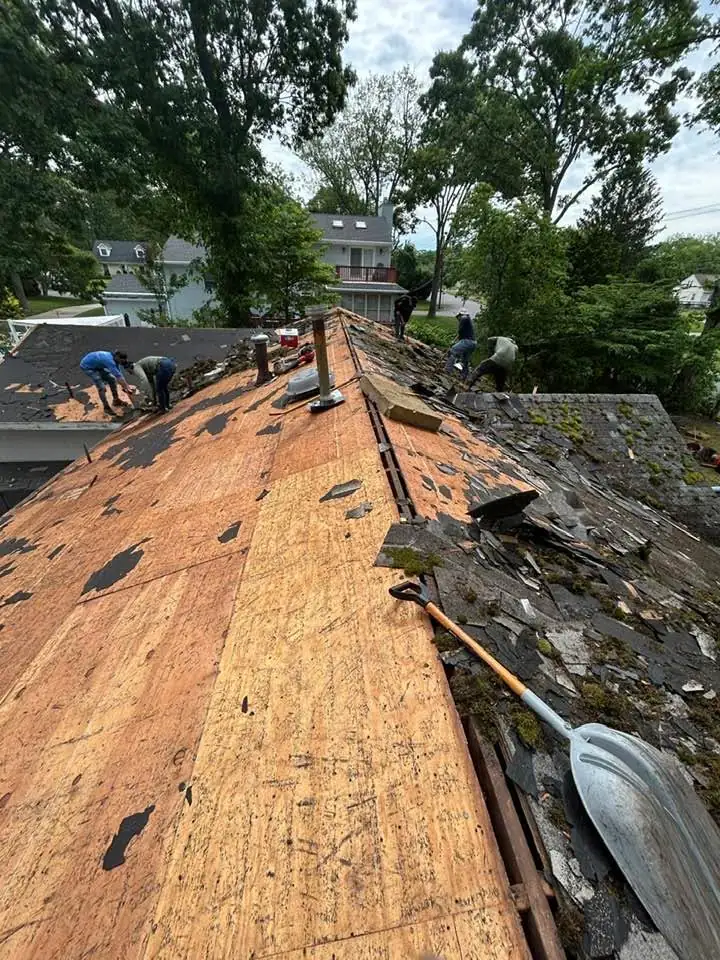
Roof Replacement service areas
We provide roof replacement from our Totowa base across these towns. Each link opens that town’s page, with local permit and building notes.
Bergen County: Allendale · Bergenfield · Cliffside Park · Demarest · Elmwood Park · Emerson · Englewood · Fair Lawn · Fairview · Fort Lee · Franklin Lakes · Garfield · Glen Rock · Hackensack · Harrington Park · Hasbrouck Heights · Hillsdale · Lodi · Mahwah · Montvale · Old Tappan · Oradell · Palisades Park · Paramus · Park Ridge · Ramsey · Ridgefield Park · Ridgewood · Rochelle Park · Rutherford · Teaneck · Tenafly · Waldwick · Westwood · Woodcliff Lake · Wyckoff
Passaic County: Clifton · Haledon · Hawthorne · Little Falls · North Haledon · Paterson · Ringwood · Totowa · Wanaque · Wayne · West Milford · Woodland Park
Essex County: Montclair · Nutley · Verona
Morris County: Morristown · Parsippany
Not listed? Call (862) 271-1225 and ask whether we cover your address.
Where we work: from our Totowa base across North Jersey
Frequently asked questions
Do you remove the old roof or shingle over it?
We tear off. Layering over old shingles hides deck damage, shortens the life of the new roof and voids most manufacturer warranties.
How disruptive is a replacement?
One to three days on site, with the property tarped and magnet-swept daily. Driveway access is needed for the dumpster and delivery.
How many shingle layers can be on a roof before it must be replaced instead of recovered?
New Jersey’s code stops a recover once a roof already has two layers of any roof covering; a third layer over that is not permitted. Most roofs we’re asked to replace already have at least one prior layer, and once a second is confirmed on site, tear-off and full replacement is the only code-compliant option left.
Does a roof replacement include new flashing?
Yes. A tear-off removes the old flashing along with the shingles, and we install new step, valley and counterflashing as part of the replacement rather than reusing bent or corroded pieces. Chimney flashing is coordinated with our chimney work when the chimney itself also needs repair or a rebuild.
Will I need to clear my driveway during the job?
Yes. Driveway access is needed for material delivery and a dumpster for the duration of the tear-off, typically parked for the full job. We’ll confirm dumpster placement and delivery timing with you before the start date so your vehicles and landscaping are out of the way.
Do you replace roof vents and boots as part of a full replacement?
Yes. Old pipe boots, box vents and any powered or ridge vents are removed with the rest of the roofing and replaced with new components sized and placed to work with the ventilation plan for that roof, not just reinstalled in their old locations.
- R908.3.1.1 Roof Recover Not Allowed (2021 IRC) — UpCodes
- Chapter 9 Roof Assemblies: New Jersey UCC One- & Two-Family Dwelling Subcode 2021 — UpCodes (New Jersey edition of the 2021 IRC)
- The Attic Needs Ventilation, But How Much Exactly? — Asphalt Roofing Manufacturers Association (ARMA)
- Roofing Materials — National Roofing Contractors Association
- Bureau of Construction Project Review — New Jersey Department of Community Affairs, Division of Codes and Standards
- Local (Regional) Code Enforcement Offices — New Jersey Department of Community Affairs, Division of Codes and Standards
Updated September 2026 · Reviewed by Edgar Lopez Gonzalez, owner · NJ HIC #13VH13359900
Licensed & insured. 25+ years in North Jersey. We answer 24/7 for leaks and storm damage.
- Service
- Roof Replacement
- Category
- Roofing
- Service area
- Bergen & Passaic County and surrounding North Jersey
- License
- NJ HIC #13VH13359900